Announcement: Meet Learnvia at MAA MathFest 2026 in Boston, Booth #122!
Our Research
Approach
We draw on a long history of applied work at the intersection of learning science and educational technology.

Learning: Measured and Improved
At Learnvia, research is not an afterthought—it’s the foundation of everything we build. Our approach is rooted in the learning sciences and Carnegie Mellon University’s decades of research at the intersection of cognitive psychology, education, and technology. Features, insights, and updates all stem from one core question: What truly helps students learn, and how can we support faculty while reducing pain points?

Faculty as Partners in Research
At Learnvia, teaching is a form of authentic research. Our research program empowers faculty to act not as end-users, but as co-investigators. Through partnerships with CMU’s Eberly Center for Teaching Excellence & Educational Innovation, we adopt the Teaching as Research (TAR) model—supporting instructors in posing their own teaching questions, running experiments, and contributing to both course improvement and the broader understanding of learning.

Faculty Fellows and Pilot Collaborations
Educators work alongside Learnvia’s research and development teams to test, iterate, and improve courseware features.

Community-Based Research
Educators engage in action research cycles—posing questions about their practice, reviewing their classroom data, and sharing findings with peers in community meetings or symposia.

Rapid Feedback Cycles
Continuous iteration ensures insights move quickly from classroom to
platform design.

Our Goal
Foster communities of practice to build and share insights into strong teaching practices in mathematics and with the Learnvia courseware.
Evidence of Student Success
Learnvia’s courseware is instrumented for learning. Every lesson, quiz, and interaction provides data that helps us understand how students engage, persist, and master concepts. Our research team uses this data—combined with direct student and faculty feedback—to refine both pedagogy and technology.
We build on well-established learning science principles, including:
Learning by Doing with Immediate Feedback
Correcting misconceptions and reinforcing understanding in real time.

Worked Examples
Deepening comprehension and reducing cognitive load.

Spaced Practice
Strengthening long-term retention through structured revisiting of key ideas.

Self-Explanation Prompts
Encouraging students to articulate reasoning, promoting conceptual mastery.

Growth Mindset and Belonging Cues
Supporting motivation, resilience, and inclusive learning environments.

Each design choice is driven by evidence—so we’re not just improving a course, we’re improving how students learn.

Continuous Improvement Through Learning Engineering
Our work follows a learning engineering process, where hypothesis-driven inquiry meets rapid iteration, grounded in data. We collect and synthesize insights through multiple research lenses:

Faculty & Student Usage Data
How courseware is used in practice.
Surveys & Observations
Insights into usability, engagement, and classroom culture.
Learning Analytics
Identifying mastery, misconceptions, and progressions.
Teaching Experience Studies
Understanding faculty satisfaction, efficiency, and instructional impact.
What Is Learning Engineering?
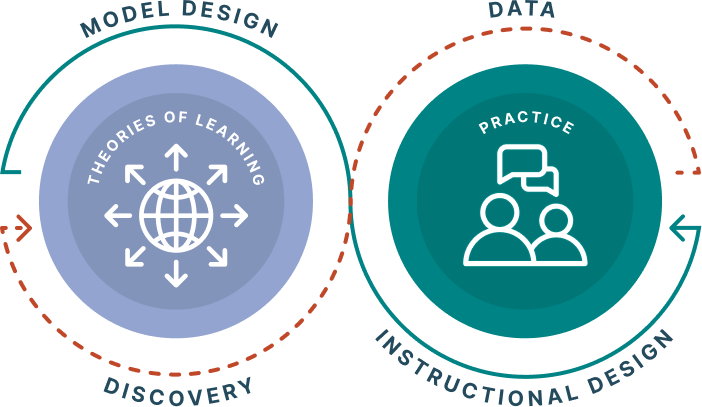
Source: LearnLab.org and Carnegie Mellon University
Learning engineering creates a dynamic feedback loop in which learning theories guide research and design, data analysis drives improvement, and classroom practice informs new discoveries. This ongoing cycle keeps Learnvia continuously evolving and improving as a learning ecosystem.
The Goal: Measurable, Shared Improvement
We measure success not just in test scores, but in the experiences of faculty and students. When faculty feel supported and students feel capable and connected, deep learning follows. By uniting learning science, data analytics, and human insight, Learnvia is helping education become more evidence-based, equitable, and effective—one iteration at a time.